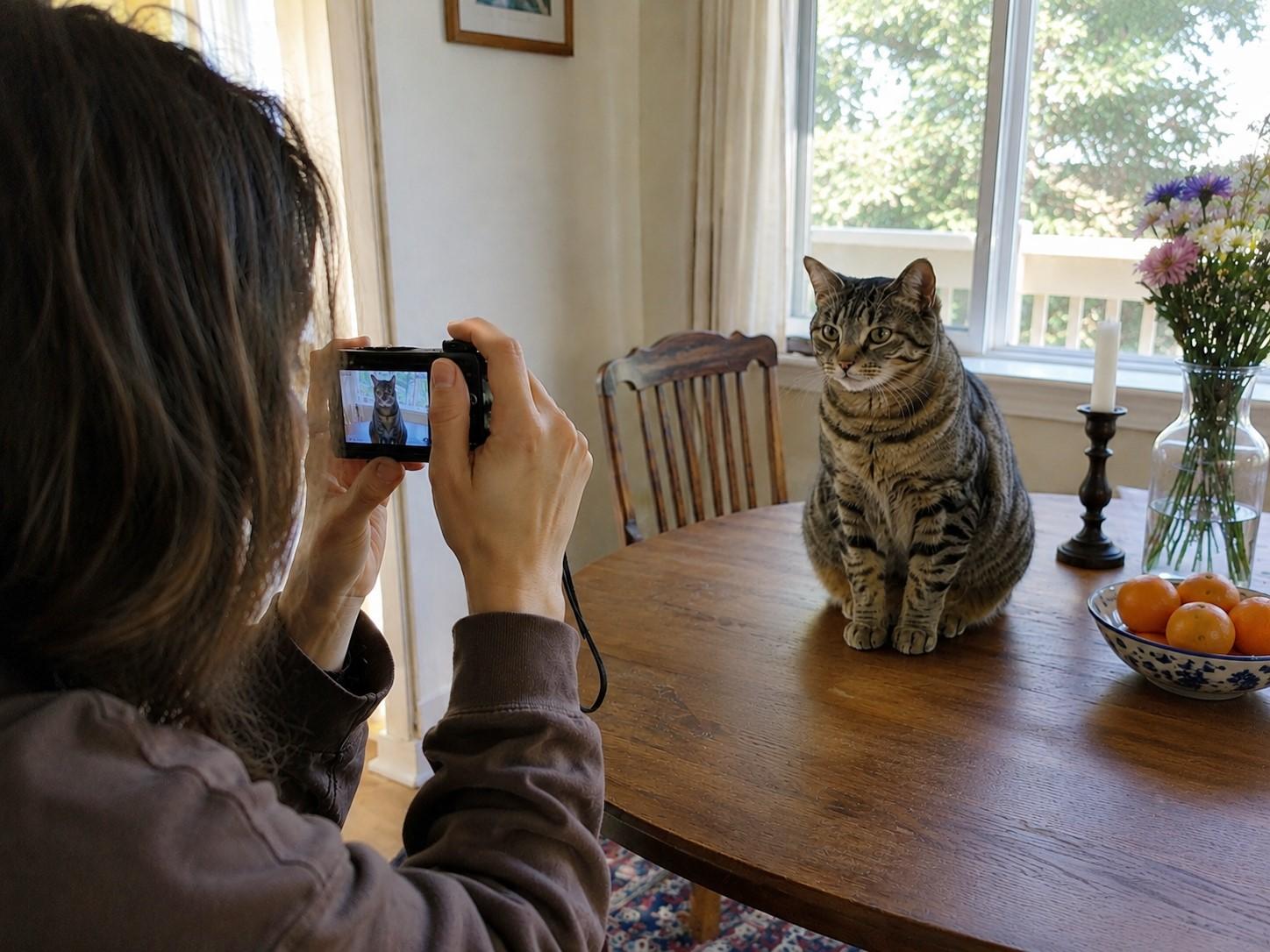
How to Photograph Your Pet for a Felted Portrait
A felted pet portrait is only as accurate as the reference photos. Bad photos produce a generic-looking pet. Good photos produce something that makes you stop in your tracks when you see it.
You don't need a professional camera. You don't need your pet to cooperate. You don't even need photos taken on purpose. Most of what we work from is phone shots taken months or years ago. But there are five things to know that meaningfully change the final result.
Why photos matter more than people expect
When we sculpt a felted pet portrait, every decision such as coat colour, eye shade, ear angle, the slight asymmetry that makes your pet yours and not someone else's, comes from the reference photos. There's no breed standard we work from. Two Golden Retrievers don't look the same. Your two cats don't look the same. The portrait is a direct translation of what's in your photos.
So when we say "send us 5+ photos," we mean: more reference equals more accuracy. Not because we're checking a box, but because the third photo tells us something the first two didn't, and the eighth shows us your pet's actual personality.
The five photos we need
These are the bare minimum. If you can send more, send more.
1. Front view of the face
Pet looking roughly toward the camera, head straight on. We use this to set the eye spacing, nose position, ear set, and overall face symmetry.
2. Left side profile
Pet seen from the left side. The whole head should be visible.
What we're looking for: the muzzle shape, ear length and angle, the line of the neck and shoulder. Side profiles tell us a lot that front views can't, particularly nose length, forehead slope, and ear depth.
3. Right side profile
Same as the left, from the other side.
Why both: most pets aren't perfectly symmetric. One ear might be slightly different. There might be a marking on one cheek and not the other. We want to know about it.
4. Three-quarter angle
Halfway between front and profile, showing both eyes plus the muzzle in dimension.
This is the magic angle for catching dimensional features. The way the brow sits over the eyes, how the muzzle protrudes, the bulk of the cheeks. It's also the angle most photographers naturally shoot, so you probably already have plenty.
5. The top of the head
A top-of-head photo helps our needle felting artisans capture ear placement, fur parting, and crown swirls that other angles miss. Sharing it alongside front and side views ensures your handmade pet portrait truly looks like your beloved companion.
What also helps
These are bonuses, not requirements. If you have them, send them.
- Full body shot. Standing, sitting, or lying down, anything that shows the body proportions and how the pet holds themselves. Especially important for 3D sculptures.
- A "signature pose" photo. If your pet always does a specific thing, such as a head tilt, an ear-flick, the "loaf" sit, a paw-up beg, and you want that captured, send a photo of it.
- Photos in different lighting. Coat colours look different in shade vs sunlight. Two photos of the same dog in different light can tell us whether the coat is a warm or cool tone.
- Photos with familiar objects nearby (sofa, doorway, treat tin). These help us estimate size and proportion if you're not sure of the dimensions.
Lighting
You don't need a photo studio. Just simply:
- Daylight. Natural light from a window, an outdoor patio, or a shaded outdoor space is ideal. Hard noon sun creates strong shadows that can hide coat patterns.
- No flash. Flash flattens the face, blows out highlights, and shifts the eye colour (the classic glowing-eye look).
- Good colour temperature. Natural daylight gives the truest colours for matching wool to your pet's coat. Since our artisans select every shade directly from your photos, a well-lit image helps your handmade needle felted portrait capture your pet's real colours.
Angle, height, and framing
A few small things that improve a photo more than people expect:
- Get to their level. Photos taken from human standing height show mostly the top of a dog's head and miss the face. Photos taken on the eye-level with your pet are always the best.
- Fill the frame with the pet. A photo of a cat in the middle of a wide room shows you very little. Get close enough that the head fills a meaningful portion of the frame.
- In focus on the face. A blurry pet against a sharp background is going to be hard for artisans to read. Tap the pet's face on your phone before shooting so the camera focuses there.
Working with pets that won't cooperate
Most pets won't pose. We assume this.
- Use treats or a toy held near the camera. Hold the treat right next to the lens for a couple of seconds. It gets a focused look.
- Photograph during quiet moments. A drowsy pet on the sofa is easier to photograph than an excited one.
- Shoot continuously. Phone burst mode catches the half-second your pet is actually facing you. One of those frames will be the keeper.
- Spread it over several days. You don't need to gather all five photos in one session. Build a small collection over a week.
When your pet has passed
This is more common than you might think, and we're set up for it.
Most pet memorial portraits are made from the photos owners already have. Pull from:
- Your phone's camera roll (especially "favourites" folders)
- Social media posts and stories
- Family members' phones, because friends and partners often have photos you don't
- Screenshots from old videos (modern phone videos pause well into clear stills)
- Printed photos from before the smartphone era
We've made portraits from as few as three photos when that's all there was. We've also made portraits from forty. The first scenario means we lean harder on what the photos show; the second gives us more to triangulate. Both are doable.
If you're worried your photos aren't "good enough," send them anyway. Let us tell you what we can work with.
A note on whiskers, fur, and other keepsakes
Several customers send us their pet's actual whiskers, small fur clippings, or other physical keepsakes to incorporate into the portrait. If you have these and want them included, mention it when you order and we'll send instructions for safely shipping them. We film the moment of placement and send you the footage.
This isn't required, and most portraits don't include any of this. But for memorial pieces, it can make the finished sculpture feel more like the pet themselves.
What to send and where
Once you've placed your order, send your photos to the email address in the confirmation. Original full-size files are ideal.
If you have a lot of photos and aren't sure which to pick, send 15-20 and we'll choose the best ones.
If you have questions before ordering, contact us — we'll happily review your existing photos and tell you whether we have enough to work from.